

Application guide
Resin for Hand Lay-Up Process
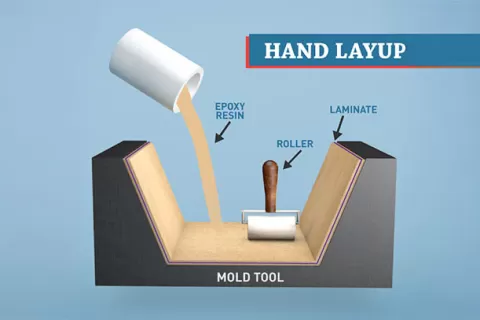
Hand lay-up is the most common FRP fabrication method, and it depends on a resin that wets out reinforcement by hand without dragging or pooling.
Smooth hand application, no dragging.
What manufacturers build
Why this material suits the work
Required resin characteristics
- A viscosity that spreads smoothly under a brush or roller without dragging
- Even wet-out through reinforcement without leaving dry fibres or resin-rich pockets
- A gel time long enough to complete a layer by hand, but fast enough to keep production moving
- Reliable room-temperature cure with no special equipment required
- Predictable behaviour across different ambient workshop temperatures
Process context
Advantages
- Viscosity tuned for smooth manual application without excessive dragging or pooling
- Sub-8-minute gel time balances a workable application window against production speed
- Non-accelerated cure system lets fabricators fine-tune dosage for the day's workshop temperature
- Consistent 99% purity keeps hand-applied laminate quality uniform from batch to batch
Common products
- Water tanks, cooling tower panels and roofing sheets
- Boat hulls and marine components
- Door skins and general FRP panels
- Moulded FRP parts across most general-purpose applications
Common questions
It needs a viscosity that spreads evenly under a brush or roller without dragging, and a gel time that gives the fabricator enough working time to wet out a full layer of reinforcement by hand before it starts to set.
It is cured at room temperature with an MEKP catalyst (around 1.5%) and a cobalt octoate accelerator (around 0.4%), with dosage commonly adjusted to suit ambient workshop temperature and the size of the part being laminated.
This depends on the part's required thickness and the resin's gel time — fabricators typically wet out and roll one layer of reinforcement before adding the next, continuing until the specified laminate thickness is reached.
Yes. GP Clear Resin wets out both, and many hand lay-up jobs combine chopped strand mat for bulk with woven roving where extra structural strength is needed.
It's used across production volumes from small custom jobs to large-scale manufacturing of tanks, panels and sheets — output scales with the number of moulds and fabricators working, rather than the process itself being a bottleneck.
Need resin for your hand lay-up production?
Get a bulk quote or talk to our technical team about the right grade and dosage for your lay-up process.
Contact Samrat FRP Traders