

Enquire on WhatsApp

Application guide

Epoxy Clear Casting Resin for River Tables & Wood Furniture

Live-edge river tables need a resin that stays optically clear against wood grain, resists shrinking away from the timber edge, and can be poured in successive ~30 mm stages to reach full tabletop thickness — exactly what Epoxy Clear Casting Resin's low-shrinkage, 2:1 epoxy system is formulated for.

Clear casting that holds its bond to wood.

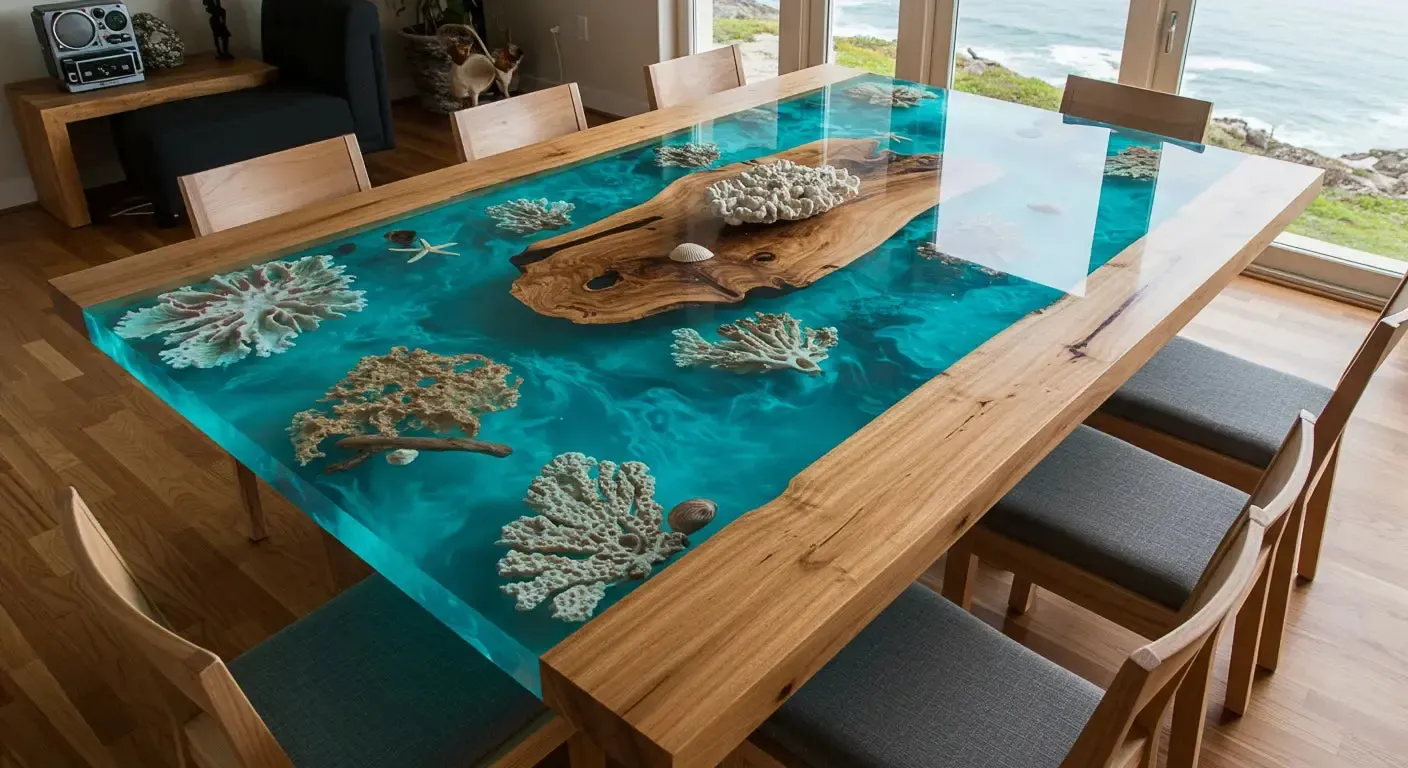
A river table is built by casting clear resin into the gaps of a live-edge wood slab — sealed edges, a clear void where bark or sapwood grain runs, or an intentional channel down the centre — then flush-sanding the cured resin level with the wood. Getting a river table right depends on a resin that stays optically clear against the wood grain, bonds securely to the timber edge without pulling away as it cures, and can be poured in stages to reach the depth most tabletop channels actually need. Epoxy Clear Casting Resin, Samrat FRP Traders' 2:1 two-part epoxy system, is built for exactly this kind of medium-depth decorative casting.

What manufacturers build

River table makers and furniture workshops build dining and coffee tables, benches, shelving and decorative panels from live-edge wood slabs — walnut, mango, acacia and similar timbers are common choices — cast with a clear or lightly tinted resin channel or void. The same technique extends to smaller wood-resin pieces: cheese boards, coasters, clocks and wall art built around a wood-and-resin combination.

Why this material suits the work

A river table's resin channel is rarely a single 30 mm pour — most river channels or tabletop pours are built up in successive stages, each poured once the previous layer has reached its initial cure, which keeps exotherm heat manageable and avoids the cracking risk of trying to pour a whole table's depth in one go. Epoxy Clear Casting Resin's 2:1 mix ratio, 900 cPs viscosity and under 0.2% shrinkage support this staged approach: because it shrinks so little on cure, it holds its bond to the wood edge rather than pulling away and leaving a visible gap line — the most visible flaw a finished river table can have. Its UV-stabilised formulation resists yellowing better than a standard, unstabilised epoxy, genuinely useful for a tabletop that sits under window light for years, though like any clear epoxy it is not permanently immune to gradual colour change under prolonged, intense UV exposure.

Required resin characteristics

  • Low shrinkage to keep a tight, gap-free bond against the wood edge as the resin cures
  • Optical clarity that doesn't compete with or distort the wood grain it's cast against
  • A mix ratio and pot life practical for staged, multi-layer pours on a large horizontal surface
  • Enough hardness once fully cured to be flush-sanded and finished level with the surrounding wood
  • UV-stabilised colour retention for a piece that will sit under window or room light for years

Process context

Before any resin is poured, the wood slab is sealed with a thin coat of resin brushed over the cut faces and edges — this stops trapped moisture and air in the wood from off-gassing into the main pour later and causing bubbles. The edges where wood will meet resin are lightly sanded so the cured resin bonds mechanically as well as chemically. A dam is then built around the slab — typically a wood frame lined with sealing tape so cured resin releases cleanly, with the seams sealed with silicone caulk to stop liquid resin leaking out before it gels. Epoxy Clear Casting Resin is mixed 2:1 by weight with Epoxy Hardener, poured in a stage up to around 30 mm deep, and any surface bubbles are released with a heat gun or torch passed briefly over the pour. Once that stage reaches its initial cure — typically the 24-hour mark — the next stage is poured on top, repeating until the full channel depth is reached. After the full 72-hour cure, the piece is released from its dam, flush-sanded level with the wood, and finished.

Advantages

  • Under 0.2% shrinkage keeps the resin bonded tight to the wood edge rather than pulling away
  • 900 cPs viscosity supports staged, multi-layer pours without excessive dragging
  • UV-stabilised formulation resists yellowing better than a standard, unstabilised epoxy
  • Shore D 82 hardness once fully cured supports flush-sanding and a durable tabletop finish

Common products

  • River-style dining and coffee tables
  • Live-edge benches and shelving
  • Cheese boards, coasters and small wood-resin decor
  • Wall art and clock faces built around a wood slab

Common questions

Can Epoxy Clear Casting Resin fill a whole river table channel in one pour?

Not usually in a single pour. Its verified maximum casting depth is around 30 mm per pour, so most river table channels — which are often deeper than that — are built up in successive stages, each poured once the previous layer has reached its initial cure. This is standard practice for epoxy casting generally, not a limitation specific to this product.

Will the resin pull away from the wood edge as it cures?

Epoxy Clear Casting Resin's shrinkage is under 0.2% once fully cured, which is why it suits this application — a resin that shrinks more can leave a visible gap line at the wood-to-resin seam, the most visible part of a finished river table.

Does Epoxy Clear Casting Resin stay clear under a window or lamp long-term?

It uses a UV-stabilised formulation that resists yellowing significantly better than a standard, unstabilised epoxy. No clear epoxy is permanently immune to gradual colour change under prolonged, intense UV exposure, so this is best understood as yellowing-resistant rather than an absolute guarantee.

Do I need to seal the wood before pouring resin for a river table?

Yes — sealing the cut faces and edges of the wood slab with a thin coat of resin first is standard practice. It stops moisture and air trapped in the wood grain from off-gassing into the main pour and causing bubbles at the wood-resin interface.

What is the difference between Epoxy Clear Casting Resin and Epoxy Art Resin for a river table?

Both are 2:1 epoxy systems. Epoxy Clear Casting Resin is suited to the depth of the river channel itself, poured in stages. Some makers finish the flush-sanded tabletop with a final thin, self-levelling flood coat — that thin, flat top layer is Epoxy Art Resin's role, not this product's.

How is Epoxy Clear Casting Resin catalysed for river table work?

It is mixed 2:1 by weight with a compatible Epoxy Hardener, weighed on a scale rather than measured by volume, since accurate weight ratios matter more here than with a polyester resin dosed by catalyst percentage.

Need Epoxy Clear Casting Resin for your river table build?

Get a bulk quote for Epoxy Clear Casting Resin, or talk to our technical team about staging your pour depth and dosage.

Contact Samrat FRP Traders